
Project for a Public Monument
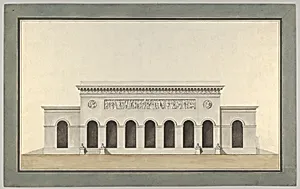
Medium
Pen and black ink, with gray and brown wash, over black chalk underdrawing, with a blue wash border
Dimensions
sheet: 15 3/16 x 24 3/8 in. (38.5 x 61.9 cm)
Classification
Drawings
Department
Drawings and Prints
Museum
Metropolitan Museum of Art, New York, NY
Credit
Purchase, Alain and Marie-Christine van den Broek d'Obrenan Gift, 2008
Accession Number
2008.598
Rights
Public Domain
Tags
Art Historical Context
Alexandre-Théodore Brongniart (1770–1847), a prominent French neoclassical architect and son of the renowned naturalist Alexandre Brongniart, created this intricate *Project for a Public Monument* (n.d.). Rendered as a preparatory drawing, it envisions a grand architectural structure adorned with human figures and integrated buildings, reflecting the era's fascination with monumental civic art. During the late 18th and early 19th centuries, such designs symbolized national pride and Enlightenment ideals, often proposed for public spaces in post-Revolutionary France. The artwork showcases Brongniart's masterful mixed-media technique: black chalk underdrawing provides the foundational structure, overlaid with precise pen and black ink lines for crisp details, and enriched by gray and brown washes to model light, shadow, and depth. A subtle blue wash border frames the composition, enhancing its presentation as a formal proposal. This labor-intensive process was typical of architectural drawings, allowing architects to communicate scale and drama to patrons or committees. Acquired by The Metropolitan Museum of Art in 2008 through the generous gift of Alain and Marie-Christine van den Broek d'Obrenan, this sheet (15 3/16 x 24 3/8 in.) offers a window into unbuilt visions of grandeur. Though unrealized, it highlights Brongniart's role in shaping neoclassical public spaces, blending human scale with imposing architecture for enduring civic inspiration.