
Design for a Façade
mid-18th century
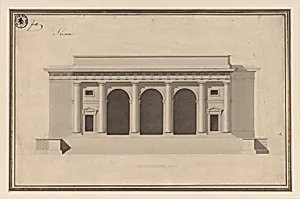
Medium
Pen and black ink, brush and gray wash
Dimensions
12 1/2 x 19 3/4 in. (31.8 x 50.2 cm)
Classification
Drawings
Department
Drawings and Prints
Museum
Metropolitan Museum of Art, New York, NY
Credit
Gift of Mr. and Mrs. Charles Wrightsman, 1970
Accession Number
1970.736.17
Rights
Public Domain
Tags
Art Historical Context
This exquisite *Design for a Façade*, created anonymously by a French artist in the mid-18th century offers a glimpse into the grandeur of French architectural drafting during the Rococo era. Rendered in pen and black ink with brush and gray wash on a sheet measuring 12½ x 19¾ inches, it meticulously outlines an elegant building front, likely intended for a hôtel particulier or public structure. The precise lines delineate columns, pediments, and ornate details, while subtle gray washes evoke depth, shadow, and light, bringing the stonework to life on paper. In 18th-century France, such drawings were essential tools for architects and patrons, bridging imagination and construction amid the opulent building boom fueled by aristocratic wealth and Enlightenment ideals. The anonymous creator reflects the collaborative workshops of the time, where skilled draftsmen produced visions for Versailles-inspired facades or Parisian townhouses. Techniques like ink linework for structure and wash for tonal modeling highlight the medium's versatility, allowing quick yet sophisticated proposals. Today, housed in the Metropolitan Museum of Art's Drawings and Prints department as a gift from Mr. and Mrs. Charles Wrightsman in 1970, this work captivates with its frozen elegance, reminding us how paper designs shaped the enduring skylines of France.
About the Artist
Anonymous, French, 18th century · 1700–1800
The artist known as Anonymous, French, 18th century, represents a collective of unidentified talents active roughly between 1700 and 1800, a period of profound artistic evolution in France from the opulent Rococo to the austere dawn of Neoclassicism and Revolutionary fervor. Little is documented about their personal training or mentors, as their anonymity obscures individual biographies, though th...