
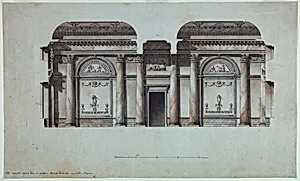
Wall Elevation, Alexander Palace, Tsarkoie-Selo, Russia
Classification
architecture
Department
Smithsonian Collection
Museum
Smithsonian American Art Museum
Credit
Museum purchase through gift of various donors and from Eleanor G. Hewitt Fund
Accession Number
1938-88-4218
Rights
Public Domain
About this artwork
Research in Progress
Art Historical Context
Step into the neoclassical elegance of Giacomo Quarenghi's *Wall Elevation, Alexander Palace, Tsarskoye Selo, Russia* (1792–96), a precise architectural drawing from the Smithsonian Art Museum's collection. Quarenghi, an Italian (1744–1817) renowned for his work in Russia, crafted this elevation—a detailed side view rendering the palace's facade with balanced proportions and classical symmetry. Acquired through museum purchase and the Eleanor G. Hewitt Fund it exemplifies his mastery in translating grand imperial visions onto paper. Commissioned during the late reign of Catherine the Great, Quarenghi served as her favored architect, blending Italian Renaissance influences with emerging neoclassicism. The Alexander Palace, located in the imperial estate of Tsarskoye Selo (now Pushkin, near St. Petersburg), was built for Grand Duke Alexander Pavlovich, who later became Tsar Alexander I. This drawing captures the palace's refined exterior, highlighting Quarenghi's emphasis on harmony, light, and proportion—hallmarks of Enlightenment-era design that symbolized Russia's cultural aspirations. Though research continues, this work offers a window into 18th-century European-Russian exchange, where Italian expertise elevated Russian architecture. Imagine strolling Tsarskoye Selo's gardens, the palace's walls rising in elegant white stone—just as Quarenghi envisioned. (198 words)