
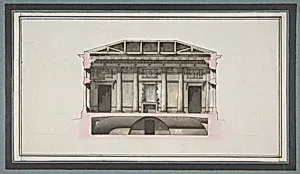
Project for the Alexander Palace, Tsarskoe Selo (Section)
1744–1817
Medium
Pen and black ink, brush with pink, gray and ocher wash, over ruled construction lines in graphite
Dimensions
5 7/16 x 9 7/8in. (13.8 x 25.1cm)
Classification
Drawings|Ornament & Architecture
Department
Drawings and Prints
Museum
Metropolitan Museum of Art, New York, NY
Credit
Gift of Mrs. Charles Wrightsman, 1997
Accession Number
1997.143.2
Rights
Public Domain
Tags
Art Historical Context
Giacomo Quarenghi a prominent Italian neoclassical architect (4–1817), this exquisite architectural drawing as a "Project the Alexander Palace, Tskoe Selo ()." Rendered in pen and black ink with subtle brush washes in pink, gray, and och over precise graphite construction lines, it just 5 7/16 x 9 7/8 inches. Housed in the Metropolitan Museum Art's Drawings and Prints, this gifted work from Mrs. Charles Wrightsman a cross-sectional view of the grand palace in Tsarskoe Selo, the imperial residence near St. Petersburg. Quarenghi, invited to Russia by Catherine the Great, became a master of neoclassicism, blending ancient Roman grandeur with rational symmetry. The Alexander Palace, later home to Tsar Nicholas II and his family, exemplified Enlightenment ideals of elegance and proportion during the late 18th century. This drawing reflects the era's architectural ambition, where palaces served as symbols of imperial power and cultural sophistication amid Russia's Europeanization. The technique showcases Quarenghi's precision: ruled lines ensure structural accuracy, while delicate washes add depth and materiality, evoking marble and light-filled interiors. For visitors, it's a window into vanished royal splendor, highlighting how drawings like this guided the transformation of Russian landscapes into neoclassical masterpieces.