
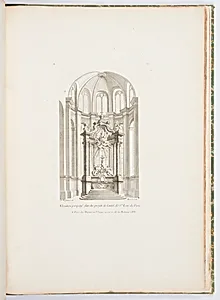
Projet de l'autel de St. Leu de Paris (Design for the Altar of St. Leu of Paris), plate 104, in Oeuvres de Juste-Aurèle Meissonnier (Works by Juste-Aurèle Meissonnier)
Medium
architecture
Classification
architecture
Department
Smithsonian Collection
Museum
Smithsonian American Art Museum
Credit
Purchased for the Museum by the Advisory Council
Accession Number
1921-6-212-61
Rights
Public Domain
About this artwork
Research in Progress
Art Historical Context
Juste-Aurèle Meissonnier, born in Italy in 1695 and active in France until 1750, was a pioneering designer whose work helped define the Rococo style. This 1748 engraving, plate 104 from his collected *Oeuvres*, presents an architectural proposal for the altar of St. Leu in Paris. As a goldsmith, sculptor, and architect, Meissonnier excelled at blending sculpture, ornament, and spatial invention into unified, exuberant compositions. Rococo architecture favored fluid curves, asymmetry, and lavish surface decoration that broke from earlier Baroque formality. Meissonnier’s altar design captures that spirit, offering a vision of religious space that is both monumental and playfully ornate. Published as a print, the plate allowed his ideas to circulate widely among patrons, craftsmen, and fellow artists, amplifying his influence on 18th-century French interiors and church furnishings. The sheet remains a vivid record of Rococo ambition at its height, inviting viewers to imagine the glittering, sculptural presence such an altar would have commanded in a Parisian church. It stands as a testament to Meissonnier’s restless creativity and the era’s delight in transforming architecture into a feast for the eye.