
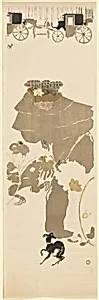
Promenade des Nourrices, Frise des Fiacres [second panel from right]
1899
Medium
4-part color lithographic screen
Dimensions
framed: 154.9 × 54 × 3.8 cm (61 × 21 1/4 × 1 1/2 in.)
Classification
Department
CG-E
Museum
National Gallery of Art, Washington, D.C.
Credit
Virginia and Ira Jackson Collection
Accession Number
1999.138.8.3
Rights
Public Domain
Art Historical Context
Pierre Bonnard's *Promenade des Nourrices, Frise Fiacres* ( panel from right), created in 1899, the lively bustle of late 19th-century Parisian life. As a key of the Nabi group—a Post-Impressionist circle influenced by Paul Gauguin and Japanese prints—Bonnard excelled in decorative arts, blending bold colors and flattened forms to evoke everyday joy. This panel, part of a four-part color lithographic screenframed at 154.9 × 54 × 3.8 cm), depicts strolling with children alongside horse-drawn fiacres, offering a vivid snapshot of Belle Époque urbanity. Printed using the innovative technique of color lithography, which allowed Bonnard to layer vibrant hues directly onto stone plates for rich, poster-like effects, the work reflects his early mastery of printmaking. Originally designed as friezes for interiors, these screens blurred the line between fine art and decoration, a Nabi hallmark that anticipated Art Nouveau's emphasis on integrated design. Housed in the National Gallery of Art's Virginia and Ira Jackson Collection (Department CG-E, Prints), this piece invites visitors to savor Bonnard's intimate gaze on transient moments—nannies chatting, carriages clattering—reminding us of Paris's vibrant social tapestry just before the automobile age.
About the Artist
Pierre Bonnard · 1867–1947
Pierre Bonnard (1867–1947) was a French painter and printmaker who became a leading figure in the Post-Impressionist movement and a founding member of Les Nabis. Born on October 3, 1867, in Fontenay-aux-Roses, France, Bonnard initially studied law at his father's insistence, graduating and briefly practicing as a barrister in 1888. However, his true passion lay in art, and he had simultaneously at...