
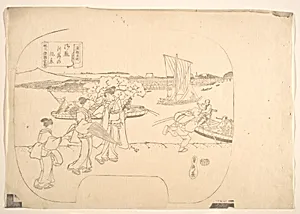
Proof Line-Block Print for Fan
19th century
Medium
Proof line-block print; ink on paper
Dimensions
Image: 11 3/4 x 9 1/2 in. (29.8 x 24.1 cm)
Classification
Prints
Culture & Period
Japan · Edo period (1615–1868)
Department
Asian Art
Museum
Metropolitan Museum of Art, New York, NY
Credit
Bequest of William S. Lieberman, 2005
Accession Number
2007.49.281
Rights
Public Domain
Tags
Art Historical Context
This exquisite proof line-block print for a fan, created bytagawa (Gountei) Sadahide in 19th-century Japan during the Edo period (5–1868), the vibrant spirit of ukiyo-e, or "pictures of the floating." Sadahide, a master of the Utagawa alongside luminaries like Hiroshige and Kuniyoshi, specialized in dynamic scenes of everyday life, often infused with humor and social observation. Here, the intricate black ink outlines depict men and women aboard boats, evoking leisurely outings on rivers or bays—a popular motif reflecting Japan's urban pleasures amid the era's isolationist policies. As a proof print, this work reveals the meticulous woodblock process: carvers first etched the key lines into a block, printing them in ink on paper to check alignment before adding colors in subsequent impressions. Fans like this were affordable, portable art objects, folded into daily life for cooling or as fashionable accessories. Measuring 11¾ x 9½ inches, its fan-shaped format highlights the adaptability of ukiyo-e techniques to intimate scales. Housed in the Metropolitan Museum of Art's Asian Art Department through the bequest of William S. Lieberman, this piece offers a window into Edo Japan's print culture, where mass production democratized beauty and storytelling for all classes.
About the Artist
Utagawa (Gountei) Sadahide · 1807–1873
Utagawa Sadahide was born Hashimoto Kenjirō in 1807 in Fusa Province, in the area of modern Chiba Prefecture, Japan. In the 1820s he entered the studio of the enormously prolific and influential master Utagawa Kunisada, becoming one of Kunisada's most prominent pupils and adopting the studio name Sadahide along with the Utagawa school's celebrated lineage. By 1828 his name appeared on a monument l...