
Proof Line-Block Print for Fan
19th century
Medium
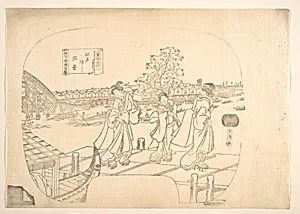
Proof line-block print for fan; ink on paper
Dimensions
Image: 12 x 9 1/2 in. (30.5 x 24.1 cm)
Classification
Prints
Culture & Period
Japan · Edo period (1615–1868)
Department
Asian Art
Museum
Metropolitan Museum of Art, New York, NY
Credit
Bequest of William S. Lieberman, 2005
Accession Number
2007.49.285
Rights
Public Domain
Tags
Art Historical Context
This exquisite proof line-block print for a fan, created bytagawa (Gountei) Sadahide in 19th-century Japan during the Edo period (1615–1868), a glimpse into the vibrant of ukiyo-e, "pictures of the world." Sadahide a prolific artist from the renowned Utagawa school, specialized in capturing everyday scenes with dynamic compositions. Here, the image likely features graceful women amid boats and bridges—a common motif evoking leisurely river outings in urban Edo (modern Tokyo), blending beauty, nature, and social life. As a proof print in ink on paper, this work represents an early stage in the intricate woodblock process: the key line-block was carved first to establish bold outlines, with colors added later in full production. Fans (ōgi or sensu) were not just functional but fashionable accessories, often adorned with such prints to showcase artistry during festivals or gatherings. Measuring just 12 x 9½ inches, its intimate scale suited the folding fan's portability. Sadahide's technique highlights the precision of Edo-period printing, where collaborative efforts between artist, carver, and printer democratized art for urban merchants and women. Bequeathed to the Metropolitan Museum of Art, this rare proof invites us to appreciate the craftsmanship behind Japan's iconic visual culture.
About the Artist
Utagawa (Gountei) Sadahide · 1807–1873
Utagawa Sadahide was born Hashimoto Kenjirō in 1807 in Fusa Province, in the area of modern Chiba Prefecture, Japan. In the 1820s he entered the studio of the enormously prolific and influential master Utagawa Kunisada, becoming one of Kunisada's most prominent pupils and adopting the studio name Sadahide along with the Utagawa school's celebrated lineage. By 1828 his name appeared on a monument l...