
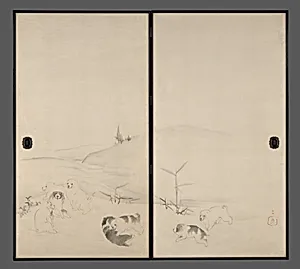
長澤蘆雪筆 雪中狗子図襖|Puppies in the Snow
1792–99
Medium
Set of four sliding panels mounted as a pair of two-panel screens; ink and color on paper
Dimensions
Image: 66 7/16 × 72 1/16 in. (168.7 × 183 cm) Overall with mounting: 68 × 74 5/8 in. (172.7 × 189.6 cm)
Classification
Paintings
Culture & Period
Japan · Edo period (1615–1868)
Department
Asian Art
Museum
Metropolitan Museum of Art, New York, NY
Credit
Mary Griggs Burke Collection, Gift of the Mary and Jackson Burke Foundation, 2015
Accession Number
2015.300.203.1, .2
Rights
Public Domain
Tags
Art Historical Context
Nestled in the crisp serenity of a snowy landscape, *Puppies in the Snow (1792–99) by Nagasawa Rosetsu captures playful exuberance of frolicking puppies on a set of four sliding panels,ounted as a pair of elegant two-panel screens. Crafted in ink and color on paper during Japan's Edo period (16151868), this work measures an impressive 66 7/16 × 72 1/16 inches, designed originally as *fusuma-e* (sliding door paintings) for intimate interior spaces. Rosetsu, a masterful Kyoto painter renowned for his eccentric and lively animal depictions, infuses the scene with dynamic energy, his bold brushstrokes bringing the pups' joyful tumbles to life amid swirling snowflakes. Rosetsu's style blends the free-spirited literati (Nanga) tradition—influenced by Chinese ink painting—with distinctly Japanese whimsy, diverging from the rigid formality of courtly Kano-school art. Dogs in Edo-era Japanese painting often symbolized loyalty and vitality, and here they evoke the period's appreciation for nature's fleeting beauty, especially in winter motifs that highlight transience (*mono no aware*). This rare surviving screen set, now in the Metropolitan Museum of Art's Mary Griggs Burke Collection, showcases Rosetsu's technical prowess in layering delicate colors over expressive ink washes, offering visitors a window into 18th-century domestic elegance and artistic innovation.