
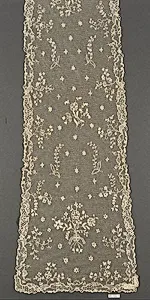
Quille (one of a pair)
Unknown Artist
18th century
Medium
Needle lace, point d’Alençon
Dimensions
L. 87 3/4 inches (222.9 cm)
Classification
Textiles-Laces
Culture
French
Department
European Sculpture and Decorative Arts
Museum
Metropolitan Museum of Art, New York, NY
Credit
Gift of Frances Morris, in memory of Mary Parsons and Catharine Newbold, 1945
Accession Number
45.122.1
Rights
Public Domain
Art Historical Context
Step into the opulent world of 18-century French fashion with *Quille*, one of pair of exquisite needle lace from the Metropolitan Museum of Art's European Sculpture and Decorative collection. Crafted in the renowned point d’Alençon technique, this nearly 88-inch-long (222.9 cm) textile exemplifies the pinnacle of lace artistry during the Ancien Régime. Originating from Alençon, France—a center of lace production regulated by royal decree—this piece was likely intended as a luxurious accessory, such as a flounce, lappet for a headdress, or garment trim, adorning the elite with its delicate, feather-light elegance. Point d’Alençon needle lace, distinguished by its fine linen threads worked entirely by hand with a needle and buttonhole stitches, required extraordinary skill and time—often hundreds of hours per piece. Developed in the 17th century and perfected in the 18th, it symbolized wealth and refinement, favored by nobility for its realistic floral motifs, intricate picots, and gimp outlines that mimicked woven fabrics. This anonymous artisan's work captures the era's rococo flourish, blending technical precision with artistic whimsy. Gifted to the Met in 1945 by Frances Morris in memory of Mary Parsons and Catharine Newbold, *Quille* invites us to appreciate the unsung labor behind France's decorative legacy—a testament to craftsmanship that turned thread into treasure.