
Quilt, applique
1851 to 1875
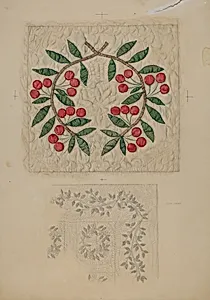
Dimensions
Original IAD Object: 86" long; 82" wide
Classification
Index of American Design
Department
CG-W
Museum
National Gallery of Art, Washington, D.C.
Credit
Index of American Design
Accession Number
1943.8.388
Rights
Public Domain
Art Historical Context
Lillian Causey's *Quilt, applique*, created between 1851 and 1875, exemplifies the of mid-19th-century American craft. Measuring an impressive 86 inches long by 82 inches wide, this substantial bed quilt showcases the appliqué technique, where fabric motifs are cut and meticulously sewn onto a foundation cloth to form decorative patterns. Though the specific medium details are undocumented, appliqué quilts like this were prized for their durability and visual storytelling, often featuring floral, geometric, or symbolic designs born from everyday materials. Documented through the Index of American Design—a New Deal-era Federal Art Project (1935–1942) that preserved vanishing American crafts—this piece highlights the ingenuity of women like Causey, who transformed scraps into heirlooms amid the challenges of antebellum and Reconstruction-era life. Quilting circles fostered community and self-reliance, turning domestic labor into a canvas for personal expression. Housed in the National Gallery of Art's collection, Causey's quilt invites us to appreciate the unsung role of folk artists in shaping American visual culture, blending utility with quiet beauty.
About the Artist
Lillian Causey · 1889–1949
Lillian Causey (1889–1949) was an American artist best known for her meticulous watercolor and graphite renderings of everyday American folk objects, created as part of the Index of American Design (IAD), a Federal Art Project under the Works Progress Administration (WPA). Active primarily between 1935 and 1942, Causey contributed hundreds of detailed illustrations to this ambitious New Deal initi...