
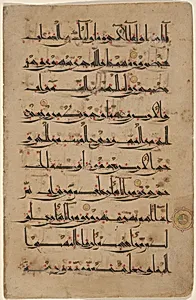
Qur'an leaf in Eastern Kufic script
11th century
Medium
Ink, opaque watercolors and gold on paper
Dimensions
31.1 × 18.6 cm (12 1/4 × 7 15/16 in.)
Classification
miniature painting
Department
Arts of Asia
Museum
Art Institute of Chicago
Accession Number
16141
Rights
Public Domain
Art Historical Context
This exquisite Qur'an leaf, hailing from the 11 century, showcases the Eastern Kufic script—a, angular style of Arabic calligraphy that emerged in regions like Persia and Central Asia during the Islamic Golden Age. As a single page from a larger manuscript of the holy Qur'an, it embodies the profound reverence for the divine word in Islamic culture, where calligraphy was elevated as the supreme art form, often surpassing figural representation. Crafted with ink, opaque watercolors, and gold on paper (measuring 31.1 × 18.6 cm), the leaf highlights masterful techniques of illumination. The gold accents and vibrant colors create a luminous effect, drawing the eye to the rhythmic flow of the monumental script, which fills the page with geometric precision and spiritual harmony. Produced amid the Seljuk era's cultural flourishing, such leaves were not mere texts but sacred objects, meticulously copied by skilled scribes for mosques, madrasas, and elite patrons. Today, housed in the Art Institute of Chicago's Arts of Asia department and classified as a miniature painting, this artifact invites visitors to appreciate the fusion of devotion, artistry, and innovation that defined medieval Islamic manuscript traditions.
About the Artist
Islamic
Islamic art, a profound visual tradition originating in the 7th century CE, flourished across vast territories from Spain to India under Muslim rule, encompassing architecture, ceramics, manuscripts, textiles, and metalwork produced by diverse artisans rather than a single named master. Drawing from pre-Islamic Sasanian, Byzantine, and late antique influences, its early development under the Umayy...