
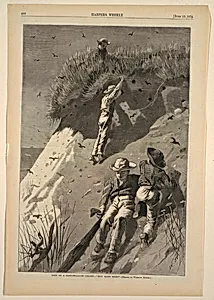
Raid on a Sand-Swallow Colony – "How Many Eggs?"
June 13, 1874
Classification
figures
Department
Smithsonian Collection
Museum
Smithsonian American Art Museum
Credit
Gift of John Goldsmith Phillips, Jr.
Accession Number
1947-4-31
Rights
Public Domain
About this artwork
Research in Progress
Art Historical Context
Winslow Homer, one of America's foremost Realist painters, captured the spirited essence of everyday life in *Raid on a Sand-Sallow Colony – "How Eggs?"*, dated June 13, 1874. Known for his masterful depictions of coastal scenes, fishermen, and the raw beauty of nature, Homer often portrayed boys engaged in adventurous pursuits along New England's shores. This work, classified among "figures" in the Smithsonian American Art's collection, likely illustrates a lively moment of youthful mischief—children raiding a colony of sand-swallows to harvest eggs, their eager question echoing the thrill of discovery. Created during Homer's prolific period of summer sketching in Gloucester, Massachusetts, the painting reflects his shift toward intimate, observational studies of American rural life in the post-Civil War era. Homer's style emphasized precise naturalism, with dynamic compositions that highlight human interaction with the environment. Though the medium remains unidentified amid ongoing research, the title suggests a humorous, narrative-driven scene infused with the artist's keen eye for light, texture, and unvarnished reality. Housed in the Smithsonian Collection through the generous gift of John Goldsmith Phillips, Jr., this piece offers a charming glimpse into 19th-century boyhood escapades, underscoring Homer's enduring legacy in celebrating ordinary moments with extraordinary skill. Visitors will appreciate its nod to timeless childhood joys amid nature's bounty.