
Raising the Wind
Medium
Hand colored etching
Dimensions
Sheet: 13 15/16 × 10 1/16 in. (35.4 × 25.5 cm)
Classification
Prints
Department
Drawings and Prints
Museum
Metropolitan Museum of Art, New York, NY
Credit
The Elisha Whittelsey Collection, The Elisha Whittelsey Fund, 1959
Accession Number
59.533.1482
Rights
Public Domain
Tags
Art Historical Context
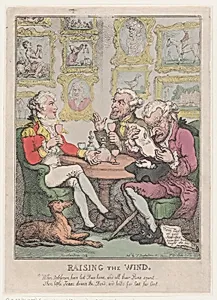
"Raising the Wind," a hand-colored etching created between 1805 and 1812 by artist Thomas Rowlandson and published by Rudolph Ackermann in London, the satirical spirit of Regency-era Britain. Rowlandson, a master caricaturist known for his witty and exaggerated depictions of social follies, collaborated frequently with Ackermann, whose firm pioneered colorful, affordable prints that brought humor to the masses. Measuring about 14 by 10 inches, this sheet from The Metropolitan Museum of Art's Elisha Whittelsey Collection exemplifies the vibrant technique of hand-coloring etchings, where artisans applied washes of watercolor by hand to enhance the black-line imagery, making these prints lively collectibles for middle-class homes. The title "Raising the Wind"—a colloquial phrase for scrambling to raise quick cash—hints at a humorous jab at financial desperation, featuring men, reading (perhaps a debt notice), and dogs in a chaotic domestic scene. Such satires critiqued the excesses of Georgian society, from gambling woes to everyday absurdities, reflecting the era's economic anxieties amid the Napoleonic Wars. Rowlandson's loose, expressive style, blending caricature with keen observation, made his works enduring commentaries on human folly. This print's cultural importance lies in its role within the booming British caricature tradition, which democratized art through inexpensive reproductions. Visitors today can appreciate how it turned sharp social critique into accessible entertainment, inviting a chuckle at timeless predicaments.
About the Artist
Rudolph Ackermann, London|Thomas Rowlandson · 1794–1832
**Rudolph Ackermann (1764–1834)** was a pivotal Anglo-German publisher, printseller, and entrepreneur whose London-based business shaped Regency-era visual culture through innovative printmaking and illustrated publications. Born in Stollberg, Saxony, he trained as a saddler and coach-builder before moving to London around 1787. He initially worked in carriage design and related trades, later esta...