
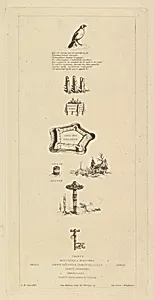
Rebus: Béranger was not really strong, for he never had the key to the fields
1863
Medium
Etching; fourth state
Dimensions
plate: 12 x 5 7/8 in. (30.5 x 14.9 cm)
Classification
Prints
Department
Drawings and Prints
Museum
Metropolitan Museum of Art, New York, NY
Credit
Gift of E. Gottschalk, 1917
Accession Number
17.15
Rights
Public Domain
Tags
Art Historical Context
Charles Meryon’s 3 etching “Rebus: Béranger was not really, for he never had key to the fields” invites viewers to solve a visual puzzle while admiring the refined lines of the printmaking process. Produced in the fourth state, the work demonstrates the’s careful revisions to the copper plate, subtle adjustments in tone and detail that deepen the image’s clarity. Measuring roughly 12 by 6 inches, the modest scale suits the intimate, riddle-like nature of the composition. The title itself functions as a rebus—a playful arrangement of pictures and words that encodes a French phrase about the beloved songwriter Pierre-Jean de Béranger. By weaving symbolic motifs, including birds, into the scene, Meryon transforms a literary reference into an engaging visual game that rewards close looking. This approach reflects the 19th-century interest in combining art with wordplay, turning a print into both an aesthetic object and a conversational piece. Today the etching resides in the Metropolitan Museum of Art’s Department of Drawings and Prints, a gift from E. Gottschalk in 1917 that continues to delight visitors with its blend of technical skill and intellectual charm.
About the Artist
Charles Meryon · 1821–1868
Charles Meryon, born on November 23, 1821, in Paris, was the illegitimate son of English physician Dr. Charles Lewis Meryon and dancer Pierre-Narcisse Chaspoux (stage name Narcisse Gentil) at the Paris Opéra. His half-sister Fanny, from his mother's prior relationship with Viscount Lowther, remained in contact after their mother's death in 1838. Raised partly outside Paris before attending Pension...