
Reclining Tahitian (fragment)
1894
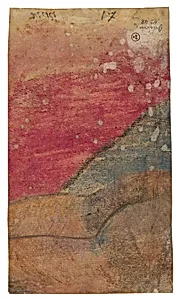
Medium
Pastel monotype, with touches of pastel, on cream wove Japanese paper, laid down on cream wove Japanese paper
Dimensions
Image/primary/secondary support: 20.4 × 11.7 cm (8 1/16 × 4 5/8 in.)
Classification
monotype
Department
Prints and Drawings
Museum
Art Institute of Chicago
Accession Number
148411
Rights
Public Domain
Art Historical Context
In 1894, Paul Gauguin created *Reclining Tahitian (fragment)* during his second stay in Tahiti, a period in his career as a Post-Impression artist. Having fled the industrialization of Europe for what he romanticized as a "primitive" paradise, Gauguin immersed himself in Polynesian culture, producing vivid works that blended European techniques with exotic subjects. This intimate pastel monotype depicts a reclining Tahitian woman, his fascination with the human form and island life—though as a fragment, it invites viewers to ponder its unfinished narrative. Gauguin's innovative use of pastel monotype stands out: he drew vibrant pastel pigments onto a plate, pressed damp Japanese paper against it to transfer the image, and added delicate touches of pastel by hand. Laid down on another sheet of cream wove Japanese paper, this 20.4 × 11.7 cm piece exemplifies his experimental printmaking, yielding a unique, painterly texture unlike traditional multiples. The choice of Japanese paper nods to his admiration for Asian art influences, enhancing the work's luminous, ethereal quality. Housed in the Art Institute of Chicago's Prints and Drawings department, this rare monotype highlights Gauguin's quest for bold color and emotional depth, influencing modern art's embrace of non-Western inspirations. A window into his Tahitian dreams, it reminds us of art's power to evoke distant worlds.
About the Artist
Paul Gauguin · 1848–1903
Paul Gauguin (1848-1903) was a French Post-Impressionist painter whose bold experiments with color, form, and subject matter made him one of the most influential figures in the transition from 19th-century art to modernism. His rejection of European civilization for the perceived authenticity of 'primitive' cultures established an archetype of artistic exile that continues to resonate. Gauguin's ...