
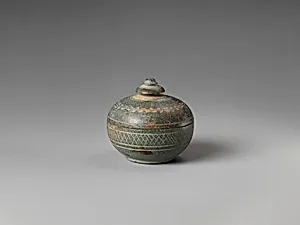
Reliquary
Unknown Artist
First three quarters of the 1st century(?)
Medium
Schist
Dimensions
Diam. 2 in. (5.1 cm)
Classification
Sculpture
Culture
Pakistan (ancient region of Gandhara)
Department
Asian Art
Museum
Metropolitan Museum of Art, New York, NY
Credit
Samuel Eilenberg Collection, Gift of Samuel Eilenberg, 1987
Accession Number
1987.142.46a, b
Rights
Public Domain
Tags
Art Historical Context
This exquisite reliquary, carved from schist in the ancient region of Gandhara (modern-day Pakistan), dates tentatively to the first three quarters of the 1st century CE. Measuring just 2 inches in diameter, this small stone sculpture exemplifies the portable devotional art of early Buddhism. Reliquaries like this one were designed to house sacred relics—such as bone fragments or ashes of enlightened beings—and were often placed within stupas or carried by pilgrims, reflecting the faith's emphasis on veneration and mindfulness. Gandhara, a cultural crossroads under the Kushan Empire, fused Hellenistic realism from Alexander the Great's legacy with Indian Buddhist motifs, birthing a distinctive Greco-Buddhist style. Though the artist remains unknown, the work's schist medium—a durable metamorphic rock—was skillfully carved to evoke spiritual potency in compact form. Its presence in the Metropolitan Museum of Art's Asian Art Department, from the Samuel Eilenberg Collection (gifted in 1987), highlights Gandhara's pivotal role in spreading Buddhism along the Silk Road. Imagine a devotee cradling this relic holder during ancient travels—its modest scale belies its profound cultural weight, bridging art, religion, and history in a single polished stone.