
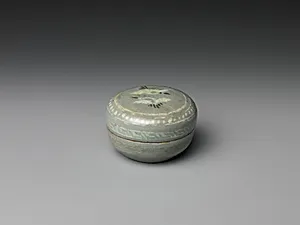
청자 상감 구름 학 무늬 모자합 고려|靑磁象嵌雲鶴文母子盒 高麗|Box from set of five decorated with cranes and clouds
Unknown Artist
13th–14th century
Medium
Stoneware with inlaid design under celadon glaze
Dimensions
H. 1 1/8 in. (2.9 cm); Diam. 1 3/4 in. (4.4 cm)
Classification
Ceramics
Culture & Period
Korea · Goryeo dynasty (918–1392)
Department
Asian Art
Museum
Metropolitan Museum of Art, New York, NY
Credit
Gift of Edna H. Bahr, 1962
Accession Number
62.97.5a, b
Rights
Public Domain
Tags
Art Historical Context
This exquisite celadon box, part of a nested set of five known as *mojahap* (mother-child boxes), hails from Korea's Goryeo dynasty (918–1392), specifically the 13th–14th century. Crafted from stoneware, it features the hallmark *sanggam* technique—inlaid designs of swirling clouds and graceful cranes created by incising motifs into the clay, filling them with white slip, and then glazing with a luminous celadon layer. Measuring just 1 1/8 inches high and 1 3/4 inches in diameter, its petite scale suggests it held cosmetics, incense, or precious small items, embodying the refined elegance of Goryeo courtly life. Goryeo celadons represent one of Korea's greatest artistic achievements, rivaling China's finest porcelains with their jade-green glaze and subtle crackle. The crane-and-cloud motif carries deep cultural symbolism: cranes evoke longevity and immortality, while clouds suggest heavenly realms, reflecting Buddhist and Confucian ideals prevalent in Goryeo society. This piece, a gift to the Metropolitan Museum of Art from Edna H. Bahr in 1962, showcases the dynasty's mastery of form and decoration, blending functionality with poetic beauty. Today, such rarities offer a window into Goryeo's prosperous era, when ceramics were prized exports and status symbols. Pause to admire how the inlay pops against the serene glaze— a testament to anonymous artisans' skill.