
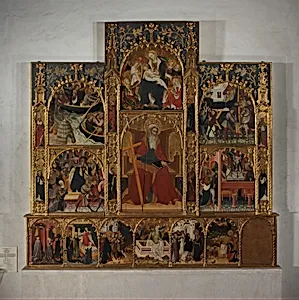
Retable with Scenes from the Life of Saint Andrew
ca. 1420–30
Medium
Tempera and gilding on panel
Dimensions
10 ft. 3 1/4 in. × 10 ft. 3 5/8 in. × 5 1/4 in. (313.1 × 314 × 13.3 cm)
Classification
Paintings-Panels
Culture
Catalan
Department
The Cloisters
Museum
Metropolitan Museum of Art, New York, NY
Credit
Rogers Fund, 1906
Accession Number
06.1211.1–.9
Rights
Public Domain
Tags
Art Historical Context
This monumental altarpiece, created around 1420–30 by the anonymous Master of Roussillon, presents vivid episodes from the life of Saint across a grand wooden structure measuring over ten feet square. Painted in tempera with lavish gold leaf on panel, the retable would have originally stood behind an altar in a Catalan church, its gleaming surfaces catching candlelight to inspire devotion among worshippers. The work belongs to a rich tradition of large-scale narrative altarpieces that guided the faithful through biblical stories and saints’ lives. Catalonia in the early fifteenth century remained deeply connected to both Gothic traditions and the emerging International Style, influences visible in the artist’s elegant figures and decorative patterning. The choice of tempera allowed for brilliant color and fine detail, while extensive gilding emphasized the heavenly realm, a technique especially prized in religious art of the period. Housed today in the Metropolitan Museum’s Cloisters, the retable offers visitors a rare glimpse into the spiritual and artistic world of medieval Spain. Among its many scenes are angels, the Madonna and Child, and even Mary Magdalene, reminding us how these works wove together multiple sacred narratives to educate and uplift the community.