
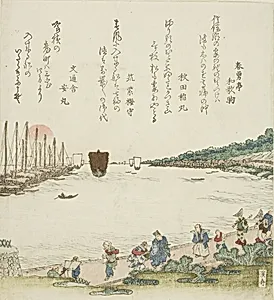
Returning sails at Takanawa
c. 1820s
Medium
Color woodblock print; shikishiban, surimono
Dimensions
20 × 18.2 cm (7 7/8 × 7 3/16 in.)
Classification
woodblock print
Department
Arts of Asia
Museum
Art Institute of Chicago
Accession Number
23411
Rights
Public Domain
Art Historical Context
In the serene "Returning Sails at Takanawa," created around the 1820s by Keisai Eisen, a master of Japan's ukiyo-e tradition we glimpse the bustling yet poetic life of Edo-period Tokyo. Takanawa, a coastal along Edo Bay, serves as the backdrop for this intimate scene of boats with billowing sails gliding homeward, capturing the rhythm of maritime commerce and daily voyages. Eisen, renowned for his delicate depictions of beautiful women (bijin-ga) and landscapes, infuses the print with a lyrical elegance, evoking the "floating world" of transient pleasures central to ukiyo-e art. This color woodblock print exemplifies the luxurious surimono format—a square shikishiban sheet (20 × 18.2 cm)—often commissioned for private New Year's greetings or poetry albums. Unlike mass-produced ukiyo-e, surimono featured premium pigments, subtle embossing, and mica flecks for a shimmering effect, reserved for elite patrons. Printed during the late Edo period (1603–1868), before stricter censorship curbed such vibrant expressions, it highlights Eisen's refined linework and harmonious color palette, blending realism with stylized beauty. Housed in the Art Institute of Chicago's Arts of Asia collection, this gem underscores ukiyo-e's global influence on modern art, from Impressionism to Japonisme. Visitors, imagine holding this tactile treasure, a window into Japan's artistic golden age where everyday sights became timeless poetry.
About the Artist
Keisai Eisen · 1790–1848
Keisai Eisen (1790–1848), born Ikeda Yoshinobu in Edo (modern Tokyo), emerged as one of the late Edo period's most prolific ukiyo-e masters. The son of the renowned calligrapher and Kanō-school painter Ikeda Shigeharu, Eisen was immersed in the arts from childhood. He apprenticed under Kanō Hakkeisai, adopting the art name "Keisai" in homage to his teacher, and later studied bijin-ga (images of be...