
Ritual Flaying Knife (Kartrika)
17th/18th century
Medium
Gilt iron
Dimensions
18.4 × 17.8 × 6.4 cm (7 1/4 × 7 × 2 1/2 in.)
Classification
ceremonial object
Department
Arts of Asia
Museum
Art Institute of Chicago
Accession Number
148387
Rights
Public Domain
About this artwork
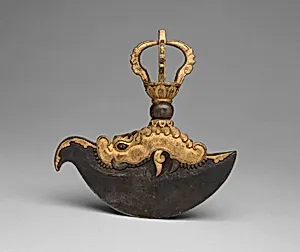
The flaying knife (kartrika) is one of the most prominent weapons used by Tantric Buddhism's angry deities, both male and female, especially the Mahakala and the Vajrayogini class of deities. They typically brandish a flaying knife in one hand and a skullcup (kapala) in the other. The blade, which is surmounted by the flayed mantle of a stylized lion, terminates in a sharp point or curved hook, and combines the flaying implements of a cutting-knife and scraping blade with the piercing activity o...
Art Historical Context
This striking Ritual Flaying Knife, known as a *kartrika*, hails from 17th- or 18th-century Asia, likely the Himalayan region where such ceremonial objects held profound spiritual significance in Vajrayana Buddhist practices. Measuring a compact 18.4 × 17.8 × 6.4 cm, it served not for practical use but as a ritual implement symbolizing the severing of ignorance, ego, or negative forces during tantric ceremonies. Often associated with wrathful deities, the *kartrika* embodies the transformative power of ritual, where the act of "flaying" represents stripping away illusion to reveal enlightenment. Crafted from gilt iron—a durable base metal lavishly coated in gold—the knife showcases exquisite metalworking techniques of the era. Gilding not only enhanced its aesthetic appeal, making it shimmer like a divine tool, but also imbued it with sacred qualities, as gold symbolized purity and the divine in Asian traditions. The intricate form, with its curved blade and symbolic hilt, reflects masterful forging and chasing, turning a fearsome tool into an object of devotion. Today, this rare ceremonial piece from the Art Institute of Chicago's Arts of Asia collection invites visitors to ponder the intersection of art, ritual, and spirituality in Himalayan culture, reminding us how everyday materials could forge profound cosmic metaphors.
About the Artist
Unknown
The artist designated as "Unknown" in our virtual museum's collection exemplifies a poignant chapter in art history: creators whose identities have faded into obscurity despite the enduring power of their work. With only one known artwork attributed to them in our holdings, this figure represents countless anonymous hands that shaped visual culture across centuries. Museums worldwide, including th...