
River Stour
1830–31
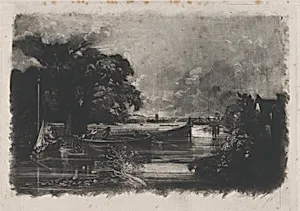
Medium
Mezzotint on chine collé; proof before published state
Dimensions
Image: 5 11/16 × 8 11/16 in. (14.4 × 22.1 cm) Plate: 8 1/4 × 10 in. (21 × 25.4 cm) Sheet: 9 11/16 in. × 14 in. (24.6 × 35.6 cm)
Classification
Prints
Department
Drawings and Prints
Museum
Metropolitan Museum of Art, New York, NY
Credit
Harris Brisbane Dick Fund, 1940
Accession Number
40.9.8
Rights
Public Domain
Tags
Art Historical Context
Step into the serene world of England's Suffolk countryside with *River Stour* (1830–31), a masterful mezzotint created through the collaboration of painter John Constable and engraver David Lucas. Constable, the celebrated Romantic artist known for his luminous landscapes of the Stour Valley—his beloved "Constable Country"—provided the oil sketches, while Lucas translated them into prints. This proof, before the published state with its final lettering, captures a tranquil river scene alive with boats, trees, and reflective waters, evoking the everyday beauty of rural life. Mezzotint, a technique pioneered in the 17th century, excels at rich tonal gradations, from deep velvety shadows to glowing highlights, perfectly suiting Constable's atmospheric effects. Printed on chine collé—thin Chinese paper adhered to a sturdy support—it achieves delicate subtlety on a modest scale (image: 5 11/16 × 8 11/16 in.). This intimate format made high-quality reproductions accessible, part of the duo's ambitious *English Landscape* series launched in the 1830s. Housed in the Metropolitan Museum of Art's Drawings and Prints department (Harris Brisbane Dick Fund, 1940), this proof offers a rare glimpse into the artistic process, highlighting printmaking's role in democratizing Romantic visions of nature. Constable's dedication to unvarnished truth in light and weather shines through, inviting visitors to feel the gentle breeze along the Stour.
About the Artist
David Lucas|John Constable · 1802–1881
**David Lucas (1802–1881)** David Lucas was born in 1802 in Geddington Chase, Northamptonshire, the son of a farmer.) A chance encounter in 1820 led him to become a pupil of the renowned engraver Samuel William Reynolds, under whom he apprenticed in London until 1827, mastering the art of mezzotint engraving.) By 1827, Lucas had published his first mezzotints, showcasing his precocious talent for...