
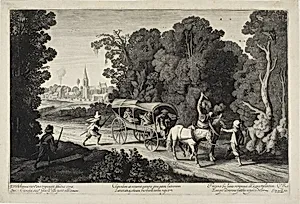
Robbers Attacking a Coach
1620–30
Medium
Etching in black on ivory laid paper
Dimensions
Plate: 28.2 × 42.6 cm (11 1/8 × 16 13/16 in.); Sheet: 30.8 × 45.6 cm (12 3/16 × 18 in.)
Classification
etching
Department
Prints and Drawings
Museum
Art Institute of Chicago
Accession Number
12161
Rights
Public Domain
Art Historical Context
Jan van de Velde II *Robbers Attacking a Coach (c. 1620–30) a tense moment of highway drama in the Dutch Golden Age a period of artistic innovation and economic prosperity in the Netherlands. As a skilled etcher and draughtsman, van de Velde specialized in lively genre scenes and landscapes, drawing from the realist traditions of contemporaries like Hendrick Goltzius. This etching on ivory laid paper exemplifies the's rise in popularity, where acid etched intricate lines into a metal plate, allowing for rich tonal contrasts and widespread reproduction—making high drama accessible beyond elite patrons. The composition, spanning a generous plate size of 28.2 × 42.6 cm, likely unfolds a chaotic roadside ambush, with robbers lunging at a defended coach amid swirling action. Van de Velde's precise, fluid lines convey motion and peril, blending narrative excitement with technical mastery. Such scenes reflected 17th-century anxieties about travel dangers on burgeoning trade routes, while entertaining viewers with moral undertones of virtue under siege. Housed in the Art Institute of Chicago's Prints and Drawings Department, this work highlights etching's role in democratizing art, inviting museum visitors to appreciate the era's blend of realism and storytelling. A thrilling window into Dutch printmaking's golden era! (198 words)
About the Artist
Jan van de Velde, II · 1593–1641
Jan van de Velde II (1593–1641) was a Dutch Golden Age printmaker and engraver whose work represents one of the high points of early seventeenth-century Dutch graphic art. Son of the calligrapher Jan van de Velde I, he was born in Delft and trained as an engraver, likely under or in close contact with the Haarlem printmaking tradition that was producing some of the most ambitious graphic work in E...