
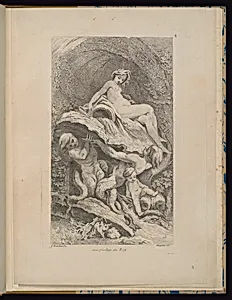
Rocaille Fountain Design
Classification
Bound print
Department
Smithsonian Collection
Museum
Smithsonian American Art Museum
Credit
Purchased for the Museum by the Advisory Council
Accession Number
1921-6-266-4
Rights
Public Domain
About this artwork
Research in Progress
Art Historical Context
François Boucher, a master of the Rococo style created this *Rocaille Fountain Design in 1736, capturing the exuberant spirit of 18th-century French decorative arts. Born in Paris in 1703, Boucher rose to prominence as the favored artist of Madame de Pompadour and King Louis XV, blending playful elegance with intricate ornamentation. Rococo, which flourished in the opulent courts of France, emphasized asymmetry, scrolling motifs, and nature-inspired flourishes—hallmarks of Boucher's whimsical yet refined aesthetic. As a bound print, this work likely served as a pattern sheet for artisans crafting fountains, gardens, or interiors, a common practice for disseminating high-style designs across Europe. The "rocaille" refers to the shell-like, rocky forms central to Rococo, evoking fantastical grottoes and lavish Versailles gardens. Though the exact medium remains under research, such prints were vital in translating painterly visions into sculpture, furniture, and architecture, influencing tastes far beyond France. Housed in the Smithsonian American Art Museum's collection—purchased by the Advisory Council—this piece highlights Rococo's global reach, bridging European luxury with American appreciation for elegant design. It invites us to imagine water cascading through ornate shells, a delightful snapshot of an era's indulgent creativity. (198 words)