
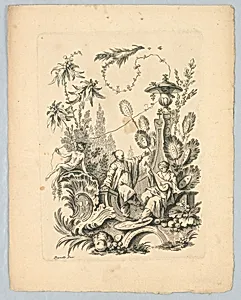
Rocaille Setting in Landscape with Classical and Chinoiserie Elements
Medium
Classification
Department
Smithsonian Collection
Museum
Smithsonian American Art Museum
Credit
Gift of Eleanor and Sarah Hewitt
Accession Number
1931-94-663
Rights
Public Domain
About this artwork
Research in Progress
Art Historical Context
Alexis Peyrotte’s *Rocaille Setting in Landscape with Classical and Chinoiserie Elements* captures the playful spirit of mid-eighteenth-century French design. Created around 1740, the print reflects the Rococo period’s love of ornate, asymmetrical forms—known as rocaille after the shell-like motifs that swirl through the composition. Peyrotte, a skilled ornamental designer, combined these fluid curves with classical ruins and delicate Chinese-inspired figures and pagodas, illustrating the era’s fascination with exotic and antique worlds reimagined for elegant interiors. As a print, the work likely served as a model for decorators, weavers, or porcelain painters seeking fashionable motifs. Its blend of styles highlights how French artists freely mixed European traditions with imported Asian aesthetics, creating a lighthearted visual language suited to aristocratic salons and garden pavilions. Today in the Smithsonian American Art Museum’s collection, the sheet offers visitors a glimpse into the inventive decorative arts that defined Rococo taste.