
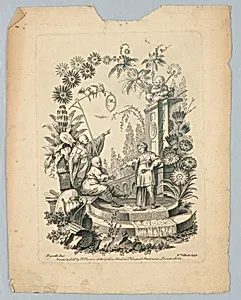
Cartouche with Chinoiserie Motifs
Classification
Department
Smithsonian Collection
Museum
Smithsonian American Art Museum
Credit
Gift of Eleanor and Sarah Hewitt
Accession Number
1931-94-666
Rights
Public Domain
About this artwork
Research in Progress
Art Historical Context
Created around 1750 by English artist William Elliott, *Cartouche with Chinoiserie Motifs* captures the playful spirit of mid-eighteenth-century design. Elliott, working during the height of the Rococo period, specialized in ornamental prints that blended European elegance with exotic inspiration. The cartouche—a decorative frame often used in prints, ceramics, and architecture—here features delicate chinoiserie elements, reflecting Europe’s growing fascination with Chinese and East Asian aesthetics through trade and travel. This print exemplifies how artists like Elliott interpreted distant cultures through a European lens, incorporating pagodas, figures, and floral patterns into fanciful compositions. Though the exact medium remains unrecorded, its classification as a print highlights the widespread popularity of such designs, which were widely circulated for use by craftsmen and decorators. Part of the Smithsonian American Art Museum’s collection through a generous gift from Eleanor and Sarah Hewitt, the work offers visitors a glimpse into the cross-cultural exchanges that shaped decorative arts in Georgian England.