
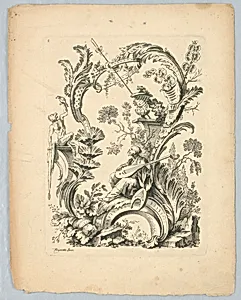
Cartouche with Chinoiserie Motifs
Classification
Department
Smithsonian Collection
Museum
Smithsonian American Art Museum
Credit
Gift of Eleanor and Sarah Hewitt
Accession Number
1931-94-664
Rights
Public Domain
About this artwork
Research in Progress
Art Historical Context
Created around 1740 by French artist Alexis Peyrotte, *Cartouche with Chinoiserie Motifs* captures the playful elegance of the Rococo period. Peyrotte, celebrated for his ornamental designs, crafted this print as a decorative cartouche—an elaborate frame—adorned with fanciful Asian-inspired elements such as pagodas, exotic figures, and delicate foliage. Though the exact medium remains unspecified, its classification as a print highlights how such designs were widely circulated for use in textiles, wallpapers, and furniture. This work reflects Europe’s eighteenth-century fascination with Chinese and East Asian aesthetics, known as chinoiserie. French artists like Peyrotte blended these imagined motifs with the light, scrolling lines of Rococo style, creating objects that felt both luxurious and worldly. The piece entered the Smithsonian American Art Museum through a generous gift from Eleanor and Sarah Hewitt, underscoring its value in documenting transcontinental design influences. Today, the print offers visitors a window into how global trade and cultural curiosity shaped European decorative arts, reminding us that even small ornamental details carried larger stories of exchange and imagination.