
Roche Vaud
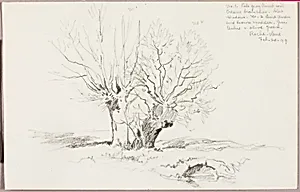
Medium
Drawing
Classification
Drawing
Department
Smithsonian Collection
Museum
Smithsonian American Art Museum
Credit
Smithsonian American Art Museum, Bequest of Carolann Smurthwaite in memory of her mother, Caroline Atherton Connell Smurthwaite
Accession Number
1983.83.254
Rights
Public Domain
Tags
Art Historical Context
Roche Vaud is a drawing from 1899 by American artist George Elbert Burr, now held in the Smithsonian American Art Museum The title points to a scene in Roche, in Switzerland’s Vaud region, a tree as a notable element. Burr’s work often captured landscapes with careful attention to form and atmosphere, and this piece reflects the late-19th-century practice of using drawing to record nature’s details with immediacy and precision. As a drawing, the medium allowed Burr to explore light, texture, and composition directly, whether as a finished work or a study. Such works were valued for their intimacy and observational quality at a time when artists frequently sketched outdoors to convey a sense of place. The artwork entered the collection through a bequest honoring family memory, underscoring how personal gifts help preserve these quiet records of the natural world for public viewing. This piece invites visitors to consider how a simple tree in a specific locale can evoke broader themes of observation and connection to the landscape, characteristic of Burr’s approach to scenery.
About the Artist
George Elbert Burr · 1859–1939
George Elbert Burr was an American printmaker and watercolorist whose career spanned the late nineteenth and early twentieth centuries, earning him a reputation as one of the foremost etchers of the American West. Born in 1859 in Monroe Falls, Ohio, Burr trained as a commercial illustrator before turning his full attention to fine art. He honed his craft through diligent self-study and close obser...