
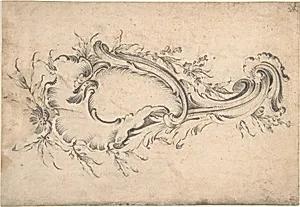
Rococo Cartouche
Medium
Black crayon
Dimensions
11 x 7 5/8 in. (27.9 x 19.4 cm)
Classification
Drawings|Ornament & Architecture
Department
Drawings and Prints
Museum
Metropolitan Museum of Art, New York, NY
Credit
The Elisha Whittelsey Collection, The Elisha Whittelsey Fund, 1949
Accession Number
49.56.14
Rights
Public Domain
Tags
Art Historical Context
This elegant black crayon drawing, created by an anonymous French artist in the 18th century, captures the essence of Rococo ornamentation. Titled simply *Roc Cartouche*, the work to the Metropolitan Museum’s Department of Drawings and Prints and forms part of the Elisha Whittelsey Collection. Measuring just over 11 by 7 inches, it exemplifies the delicate studies that designers produced to explore decorative motifs for architecture, furniture, and printed materials during the reign of Louis XV. Cartouches—ornamental frames often resembling scrolled shields or shells—were central to Rococo aesthetics, which favored asymmetry, graceful curves, and playful natural forms over the heavier symmetry of the Baroque era. Rendered in black crayon, this drawing highlights the medium’s ability to convey soft shading and fluid line work, allowing artists to test the lively interplay of scrolls and foliage before committing to more permanent materials like wood, stucco, or engraving plates. As a surviving example of ornamental design, the sheet offers modern viewers a glimpse into the collaborative world of 18th-century French decorative arts. Such studies circulated among craftsmen and patrons, helping shape the lighthearted elegance that defined Rococo interiors across Europe.
About the Artist
Anonymous, French, 18th century · 1700–1800
The artist known as Anonymous, French, 18th century, represents a collective of unidentified talents active roughly between 1700 and 1800, a period of profound artistic evolution in France from the opulent Rococo to the austere dawn of Neoclassicism and Revolutionary fervor. Little is documented about their personal training or mentors, as their anonymity obscures individual biographies, though th...