
Rocaille Ornament Design
Classification
Bound print
Department
Smithsonian Collection
Museum
Smithsonian American Art Museum
Credit
Purchased for the Museum by the Advisory Council
Accession Number
1921-6-213-8
Rights
Public Domain
About this artwork
Research in Progress
Art Historical Context
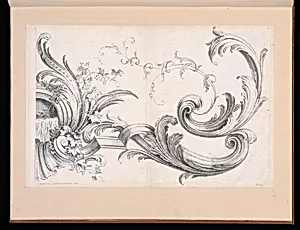
Alexis Peyrotte’s Rocaille Ornament Design captures the playful elegance of mid-eighteenth-century French decorative art. Created between 1749 and 1761, the work exemplifies the Rococo movement’s love of asymmetry, scrolling forms, and shell-like motifs—elements that gave the style its name, “rocaille.” As a bound print, it likely served as a pattern or model for craftsmen working in textiles, furniture, or interior ornament, reflecting the period’s growing emphasis on printed design sources that spread fashionable tastes across Europe. Peyrotte, a French artist active during the reign of Louis XV, contributed to the era’s shift toward lighter, more intimate decoration that contrasted with the heavier grandeur of the Baroque. Though the precise medium remains unrecorded, the print’s classification highlights its role in disseminating ornamental ideas rather than functioning as a finished painting or drawing. Acquired by the Smithsonian American Art Museum through its Advisory Council, the sheet offers visitors a glimpse into how such designs influenced the material culture of the time. Today the work stands as a quiet testament to the collaborative nature of Rococo production, where artists like Peyrotte supplied the imaginative vocabulary that artisans translated into carved wood, gilded stucco, and woven silk. Its delicate lines and rhythmic curves continue to reward close looking, revealing the inventive spirit that defined an entire aesthetic age.