
Roses
Medium
Painting
Classification
Painting
Department
Smithsonian Collection
Museum
Smithsonian American Art Museum
Credit
Smithsonian American Art Museum, Gift of Miss A. M. Hegeman
Accession Number
1942.4.2
Rights
Public Domain
Tags
Art Historical Context
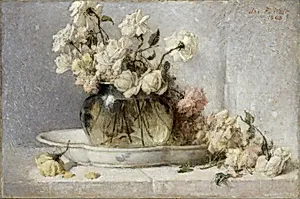
John Ferguson Weir's *Roses* (1898) is a delicate still life painting that captures the timeless beauty of flowers, likely featuring roses arranged in a dish or vase. As an American artist and educator—serving as the first director of the Yale School the Fine Arts—Weir was renowned for his precise, realistic depictions of everyday subjects. This work exemplifies the late 19th-century American still life tradition, where artists elevated humble objects into meditations on transience and natural elegance, influenced by European masters like those of the Dutch Golden Age. Painted during the Gilded Age, *Roses* reflects a period when floral still lifes symbolized refinement and the growing appreciation for domestic artistry in the United States. Weir's technique, characterized by meticulous brushwork and subtle light effects, invites viewers to savor the petals' velvety textures and soft glow, evoking a sense of quiet luxury. Though modest in scale, the painting's focus on roses underscores cultural associations with love, beauty, and fleeting life—timely themes amid rapid industrialization. Today, *Roses* graces the Smithsonian American Art Museum, a gift from Miss A. M. Hegeman, preserving Weir's contribution to American realism. It's a charming reminder of how simple blooms can bloom eternal in art.