
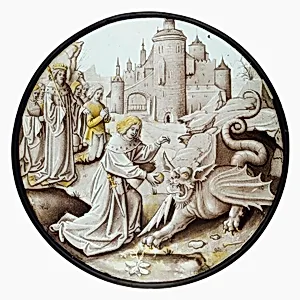
Roundel with Daniel Slaying the Dragon
ca. 1520
Medium
Colorless glass, vitreous paint and silver stain
Dimensions
Overall Diam.: 8 1/2 in. (21.6 cm)
Classification
Glass-Stained
Culture
South Netherlandish
Department
The Cloisters
Museum
Metropolitan Museum of Art, New York, NY
Credit
The Cloisters Collection, 1932
Accession Number
32.24.49
Rights
Public Domain
Tags
Art Historical Context
This delicate roundel, created around 1520 in the South Netherlands, captures the biblical story of Daniel slaying the dragon—a tale of faith overcoming false idols. Attributed to the artist known as Pseudo-Ortkens, the scene shows the prophet confronting the beast in a landscape that includes a distant castle, rendered with fine detail on a small scale of just eight and a half inches across. Such narrative roundels were popular in the early sixteenth century, often installed in windows of homes, chapels, or civic buildings to inspire moral reflection. The work exemplifies the refined glass-painting techniques of the period, using colorless glass enhanced with vitreous paint and silver stain to create subtle tones of yellow and brown. This method allowed artists to achieve luminous effects and intricate line work without the heavier leading of traditional stained-glass windows. As a product of Netherlandish workshops, the roundel reflects the region’s strong tradition of devotional art that blended religious storytelling with everyday settings. Housed today in the Metropolitan Museum of Art’s Cloisters collection, this piece offers visitors a glimpse into the intimate scale of Renaissance glass art and its enduring power to convey stories of courage and belief.
About the Artist
Pseudo-Ortkens · 1500–1530
**Pseudo-Ortkens** (also known as Pseudo-Aert Ortkens) is the conventional name given to a workshop or group of South Netherlandish artists active in the Southern Netherlands, particularly around Antwerp and Brussels, from approximately 1500 to 1540. The name arose after earlier attributions to the glass painter Aert Ortkens (Arnold of Nijmegen) proved erroneous; scholars now recognize the output ...