
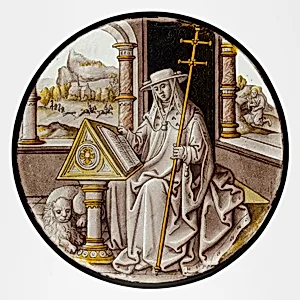
Roundel with Saint Jerome in his Study
ca. 1520
Medium
Colorless glass, vitreous paint and silver stain
Dimensions
Overall: 9 in. (22.8 cm)
Classification
Glass-Stained
Culture
South Netherlandish
Department
The Cloisters
Museum
Metropolitan Museum of Art, New York, NY
Credit
The Cloisters Collection, 1988
Accession Number
1988.304.3
Rights
Public Domain
Tags
Art Historical Context
This exquisite roundel, created around 1520 by the Pseudo-Ortkens workshop in the South Netherlandish tradition, captures Saint Jerome in his study—a beloved subject in Renaissance devotional art. The scholar-saint, renowned for translating the Bible into (the Vulgate) and his life of ascetic study, is depicted amid books and his faithful lion companion, symbolizing wisdom, humility, and divine companionship. Crafted during the Northern Renaissance, when stained glass evolved from grand cathedrals to intimate domestic settings, this 9-inch circular panel would have adorned a private chapel or burgher's home, bringing sacred imagery into everyday life. The medium showcases masterful techniques: colorless glass forms the base, enlivened by vitreous paint for fine lines and shading, and silver stain—a 14th-century innovation—that fires to produce radiant yellows and oranges, mimicking natural light's glow. South Netherlandish artists like those in the Pseudo-Ortkens circle excelled in these methods, blending Gothic detail with emerging Renaissance naturalism. Housed in The Cloisters at the Metropolitan Museum of Art (The Cloisters Collection, 1988), this roundel invites visitors to ponder Jerome's contemplative world, where reading and reflection transcend time.
About the Artist
Pseudo-Ortkens · 1500–1530
**Pseudo-Ortkens** (also known as Pseudo-Aert Ortkens) is the conventional name given to a workshop or group of South Netherlandish artists active in the Southern Netherlands, particularly around Antwerp and Brussels, from approximately 1500 to 1540. The name arose after earlier attributions to the glass painter Aert Ortkens (Arnold of Nijmegen) proved erroneous; scholars now recognize the output ...