
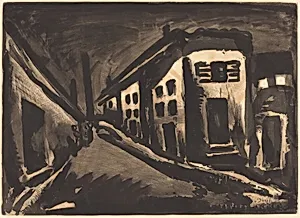
Rue des Solitaires
1922
Medium
aquatint, roulette, and drypoint over heliogravure
Classification
Portfolio
Department
CG-W
Museum
National Gallery of Art, Washington, D.C.
Credit
Rosenwald Collection
Accession Number
1950.1.164
Rights
Public Domain
Art Historical Context
Georges Rouault's *Rue des Solitaires*1922) captures the poignant isolation of urban life through a masterful printmaking technique. As a leading French Expressionist, Rouault drew from his Fauvist roots and stained-glass influences to create works thick with emotion, often exploring human suffering and solitude. This piece, part of a portfolio in the National Gallery of Art'swald Collection, evokes lonely figures on a solitary street, rendered in stark contrasts that highlight Rouault's sympathy for society's outcasts amid post-World War I disillusionment. The artwork's medium—aquatint, roulette, and drypoint over heliogravure—showcases Rouault's innovative printmaking prowess. Heliogravure provided a photomechanical base for tonal depth, which Rouault enriched by hand with aquatint for velvety shadows, roulette for gritty textures mimicking his impasto paintings, and drypoint for jagged, expressive lines. This labor-intensive layering bridges photography and traditional intaglio, amplifying the emotional intensity and rarity of his editions. Housed in the National Gallery's CG-W Department, *Rue des Solitaires* exemplifies Rouault's fusion of spiritual depth and social critique, inviting visitors to ponder the quiet tragedies of modern existence.
About the Artist
Georges Rouault · 1871–1958
Georges-Henri Rouault was born on May 27, 1871, in a Paris cellar during the violent "Bloody Week" of the Paris Commune, when a stray shell destroyed his family's home in the working-class Belleville district. Raised by a carpenter father who worked at the Pleyel piano factory and a grandfather who collected prints by Honoré Daumier, Rembrandt, Courbet, and Manet, Rouault showed early artistic pro...