
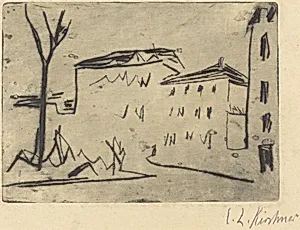
Street Corner in Dresden (Strassenecke Dresden)
Medium
drypoint on blotting paper
Dimensions
plate: 9.8 x 13.6 cm (3 7/8 x 5 3/8 in.) sheet: 18 x 22 cm (7 1/16 x 8 11/16 in.)
Classification
Department
CG-W
Museum
National Gallery of Art, Washington, D.C.
Credit
Ruth and Jacob Kainen Collection
Accession Number
1985.77.2
Rights
Public Domain
Art Historical Context
**Street Corner in Dresden (Strassenecke Dresden)** created by Ernst Ludwig Kirchner in1909, captures the energy of urban life during the artist's formative years in Dresden. Kirchner, a founding of the groundbreaking Die Br group launched in 190, was at the forefront of German Expressionism. This movement rejected naturalistic representation in favor of bold, distorted forms and vivid emotional intensity to convey modern alienation and vitality. The print depicts a street corner, likely teeming with figures and architecture, reflecting Kirchner's fascination with the dynamism of contemporary cityscapes before he shifted focus to Berlin's nightlife. Rendered in drypoint on blotting paper—a rare and experimental choice for the era—this intimate work (plate: 9.8 x 13.6 cm) showcases Kirchner's mastery of intaglio printmaking. Drypoint involves scratching directly into a metal plate with a sharp tool, yielding rich, velvety burr lines that hold ink for dramatic depth and texture. The absorbent blotting paper softens the ink's application, creating hazy, atmospheric effects that enhance the scene's immediacy and transience, almost like a snapshot of fleeting urban moments. Housed in the National Gallery of Art's Ruth and Jacob Kainen Collection (Department CG-W), this print exemplifies Kirchner's innovative bridging of painting and printmaking. It invites visitors to ponder how early 20th-century artists like him transformed everyday streets into profound expressions of modernity.
About the Artist
Ernst Ludwig Kirchner · 1880–1938
Ernst Ludwig Kirchner was born on May 6, 1880, in Aschaffenburg, Germany, to parents Ernst and Maria Kirchner, part of a family of Prussian descent that frequently relocated due to his father's career as a chemical technician. After early schooling in various towns, he studied architecture at the Königliche Technische Hochschule (Technical University) in Dresden from 1901 to 1905, taking courses i...