
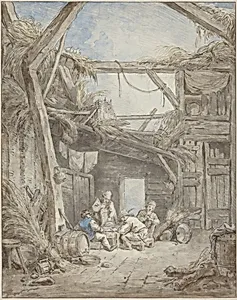
Ruined Farm
c. 1770/1775
Medium
pen and black ink with gray and brown wash, and blue watercolor, over a black chalk counterproof, with black chalk additions, on laid paper
Dimensions
Overall: 36.5 x 29 cm (14 3/8 x 11 7/16 in.) support: 45.7 x 37.6 cm (18 x 14 13/16 in.)
Classification
Drawing
Department
CG-E
Museum
National Gallery of Art, Washington, D.C.
Credit
Samuel H. Kress Collection
Accession Number
1963.15.27
Rights
Public Domain
Art Historical Context
Step into the evocative world of Hubert Robert'sRuined Farm* (c. 1770/5), a masterful drawing that captures the romantic allure of decay. This French artist, often called "Robert des Ruines," specialized in architectural capriccios—imaginary landscapes blending ancient ruins with lush nature. Working during the Enlightenment era, when fascination with classical antiquity peaked, Robert drew inspiration from his Roman sojourns and artists like Piranesi, evoking nostalgia for a vanishing past amid encroaching wilderness. Crafted on laid paper, the work employs a sophisticated mixed-media technique: a black chalk counterproof (a reversed impression serving as a tonal base) overlaid with pen and black ink, gray and brown washes, blue watercolor, and black chalk additions. This layering creates depth and atmospheric mood, with washes suggesting misty light filtering through crumbling farm structures—a humble yet grand ruin symbolizing time's inexorable march. Measuring 36.5 x 29 cm, this gem from the Samuel H. Kress Collection at the National Gallery of Art showcases Robert's skill in transforming sketches into poetic visions. It invites visitors to ponder humanity's fragile footprint, blending Neoclassical precision with emerging Romantic sentiment.
About the Artist
Hubert Robert · 1733–1808
Hubert Robert, born on May 22, 1733, in Paris, emerged from a modest background; his father, Nicolas Robert, served the influential Choiseul family, whose patronage shaped the young artist's path. After completing his studies at the Jesuit Collège de Navarre in 1751, he entered the atelier of sculptor Michel-Ange Slodtz, who taught him design and perspective before encouraging a shift to painting....