
S. Andrea via Flaminia, elevation (recto) blank (verso)
early to mid-16th century
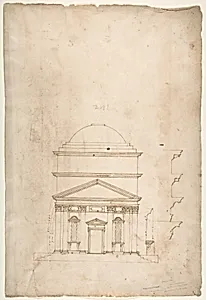
Medium
Dark brown ink, black chalk, and incised lines
Dimensions
sheet: 17 7/16 x 11 3/4 in. (44.3 x 29.9 cm)
Classification
Drawings
Department
Drawings and Prints
Museum
Metropolitan Museum of Art, New York, NY
Credit
Gift of Janos Scholz and Anne Bigelow Scholz, in memory of Flying Officer Walter Bigelow Rosen, RCAF, 1949
Accession Number
49.92.68
Rights
Public Domain
Tags
Art Historical Context
This delicate architectural drawing captures the elevation of S. Andrea along Rome's ancient Via Flaminia, a church that stood as a notable landmark in the early 16th century. by an anonymous French artist the Renaissance heyday, it reflects the era's growing fascination among northern European designers with Italy's classical and ecclesiastical architecture. French travelers and scholars, inspired by Rome's ruins and innovative buildings, often sketched such facades to bring home ideas for their own projects, bridging Italian Renaissance ideals with French Gothic traditions. Executed in dark brown ink and black chalk on a generous sheet measuring 17 7/16 x 11 3/4 inches, the work showcases precise lines that define the structure's proportions, arches, and decorative elements. The incised lines—subtle grooves scratched into the paper—reveal a practical technique: these allowed the artist to transfer the design onto another surface by pouncing charcoal dust through the pricks, a common method for replicating plans in workshops or for printmaking. Housed in the Metropolitan Museum of Art's Drawings and Prints department, this sheet, gifted in 1949, offers a window into 16th-century cross-cultural exchange. It highlights how anonymous draftsmen fueled the architectural revival, influencing designs from Paris to Provence with Roman harmony and grandeur. A testament to the portability of ideas in an age before photography.