
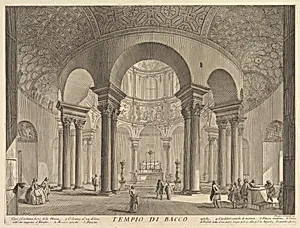
S. Constanza (erroneously callled Temple of Bacchus) (Veduta interna del Sepolcro di S. Constanza, fabbricato da Costantino Magno, ed erroneamente detto il Tempio di Bacco, inoggi Chiesa della medisme Santa), from "Vedute di Roma"
ca. 1756
Medium
Etching
Classification
Prints
Department
Drawings and Prints
Museum
Metropolitan Museum of Art, New York, NY
Credit
Harris Brisbane Dick Fund, 1937
Accession Number
37.45.3(66)
Rights
Public Domain
Tags
Art Historical Context
Step into the luminous interior of Santa Costanza with Giovanni Battista Piranesi's etching *S. Constanza (erroneously called Temple of Bacchus)*, from renowned series *Vedute di* (ca. 1756). This veduta interna captures the ancient mausoleum's soaring arches, elegant columns, and central altar, built around 350 CE by Emperor Constantine the Great as tomb for his daughter Constantia. Later converted into a church, it was long misidentified as a pagan Temple of Bacchus due to its vine-scroll mosaics evoking Bacchic themes—highlighting the blurred lines between Roman paganism and early Christianity. Piranesi, a masterful Venetian etcher and architect, transformed topography into dramatic visions of Rome's ruins. His intricate etching technique—layering fine lines to evoke depth, shadow, and atmospheric grandeur—immerses viewers in the space, emphasizing architectural splendor amid decay. As part of the 18th-century Grand Tour craze, these prints fueled fascination with antiquity, preserving sites for armchair travelers. Today, housed in the Metropolitan Museum of Art's Drawings and Prints department, this work exemplifies Piranesi's Romantic flair, blending precise draftsmanship with poetic exaggeration to celebrate Rome's enduring legacy. A window to imperial history through 18th-century eyes!
About the Artist
Giovanni Battista Piranesi · 1720–1778
Giovanni Battista Piranesi (1720–1778) was an Italian printmaker, architect, and antiquarian whose visionary etchings of Rome and imaginary prisons revolutionized architectural representation and profoundly influenced both Neoclassicism and Romanticism. Piranesi stands as one of the most important printmakers of the eighteenth century, fundamentally shaping European perceptions of ancient Rome an...