
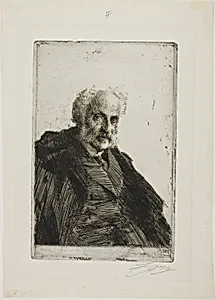
S. Loeb
1897
Medium
Etching on ivory laid paper
Dimensions
Image: 21.8 × 14.8 cm (8 5/8 × 5 7/8 in.); Plate: 23.7 × 15.5 cm (9 3/8 × 6 1/8 in.); Sheet: 32.4 × 23 cm (12 13/16 × 9 1/16 in.)
Classification
etching
Department
Prints and Drawings
Museum
Art Institute of Chicago
Accession Number
41770
Rights
Public Domain
Art Historical Context
Anders Zorn's *S. Loeb* (1897) is a masterful etching that exemplifies the Swedish artist's prowess in printmaking during the late 19th century. Zorn, renowned for his luminous portraits and nudes, captured his subjects with remarkable sensitivity to light and texture. This intimate work, measuring just 21.8 × 14.8 cm in its image area, likely depicts a portrait of the titular S. Loeb, rendered on luxurious ivory laid paper—a high-quality support that enhances the etching's subtle tonal gradations and velvety depth. Etching, Zorn's preferred medium here, involves incising lines into a metal plate with acid, allowing for delicate lines and rich blacks that mimic the fluidity of his oil paintings. By 1897, Zorn was at the height of his international fame, exhibiting widely in Europe and America, and his prints were coveted by collectors for their technical brilliance and psychological insight. The precise plate mark (23.7 × 15.5 cm) and generous sheet size (32.4 × 23 cm) underscore its status as a fine art print, housed today in the Art Institute of Chicago's Prints and Drawings department. This piece invites visitors to appreciate how Zorn bridged painting and printmaking, transforming a simple portrait into a study of character and atmosphere—perfect for savoring up close in our virtual galleries.
About the Artist
Anders Zorn · 1860–1920
Anders Zorn (1860–1920), one of Sweden's most celebrated artists, was born on February 18 in Utmeland near Mora in Dalarna, and raised on his maternal grandparents' farm in the nearby hamlet of Yvraden. Displaying prodigious talent from a young age, he attended school in Mora Strand until age twelve, followed by secondary grammar school in Enköping, where he excelled in drawing people and horses. ...