
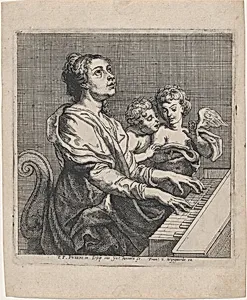
Saint Cecilia playing the virginals, accompanied by two singing angels
Medium
Etching; second state of two
Dimensions
Plate: 5 7/8 × 5 1/2 in. (15 × 14 cm) Sheet: 7 3/8 × 6 1/16 in. (18.7 × 15.4 cm)
Classification
Prints
Department
Drawings and Prints
Museum
Metropolitan Museum of Art, New York, NY
Credit
H.O. Havemeyer Collection, Bequest of Mrs. H.O. Havemeyer, 1929
Accession Number
29.107.185
Rights
Public Domain
Tags
Art Historical Context
Behold the ethereal "Saint Cecilia Playing the Virginals, Accompanied by Two Singing Angels a captivating etching from around 1631, now in the Metropolitan Museum of Art's H.O.emeyer Collection. This-state print, measuring a intimate plate size of 5 78 × 5 1/2 inches, the talents of Frans van den Wyngaerde Peter Paul Rubens, and Panneels. Saint Cecilia, the revered patron saint of music, is at the virginals—a compact, rectangular precursor to the harpsichord—flanked by two angelic singers, their faces alight with divine harmony. Rubens, the Flemish Baroque master known for his dramatic compositions and lush figures, likely contributed the dynamic design, infusing the scene with Counter-Reformation fervor. This era's art celebrated saints to inspire faith, and Cecilia's musical rapture embodies the Baroque ideal of sensory splendor uniting heaven and earth. The angels' open mouths and flowing robes heighten the print's rhythmic energy, evoking celestial concerts. Etching, the medium here, allowed precise, expressive lines etched into a copper plate with acid, enabling multiple impressions for wider dissemination of elite designs. As a collaborative print, it exemplifies 17th-century Antwerp's innovative reproductive techniques, making Rubens' vision accessible beyond oil paintings. A gem for music and devotion lovers!