
Saint George and the Dragon
c. 1506
Medium
oil on panel
Dimensions
overall: 28.5 x 21.5 cm (11 1/4 x 8 7/16 in.) framed: 53.3 x 47.6 x 8.3 cm (21 x 18 3/4 x 3 1/4 in.)
Classification
Painting
Department
CIS-R
Museum
National Gallery of Art, Washington, D.C.
Credit
Andrew W. Mellon Collection
Accession Number
1937.1.26
Rights
Public Domain
Art Historical Context
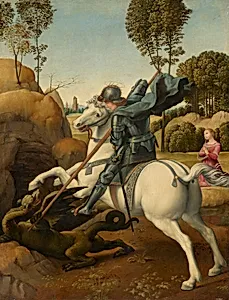
Raphael’s *Saint George and the Dragon* (c. 1506) captures the legendary tale of the Christian knight rescuing a princess by slaying a fearsome dragon. Painted when the artist was in his early twenties, this small oil-on-panel work exemplifies the High Renaissance ideals of harmony, clarity, and graceful movement that would define Raphael’s career. The compact scale—roughly the size of a large book—suggests it was created for private devotion or as a diplomatic gift rather than a grand altarpiece. Raphael balances dramatic action with serene composure: Saint George charges forward on his white horse while the princess watches calmly from a distance. The luminous landscape and precisely rendered armor demonstrate the young artist’s mastery of oil technique, which allowed him to achieve rich color and fine detail on a smooth wooden surface. Now in the National Gallery of Art’s Andrew W. Mellon Collection, the painting offers visitors an intimate encounter with one of the Renaissance’s most beloved masters at the height of his early creativity.
About the Artist
Raphael · 1483–1520
Raffaello Sanzio da Urbino, known simply as Raphael, was born on March 28 or April 6, 1483, in the cultured Duchy of Urbino to the court painter and poet Giovanni Santi and his wife Màgia Ciarla. Orphaned young—his mother died when he was eight and his father when he was eleven—Raphael was raised in Urbino's refined court under the guardianship of his paternal uncle Bartolomeo. He received his ear...