
Saint James the Greater
1501 to 1550
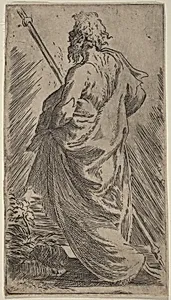
Medium
etching
Classification
Department
CG-E
Museum
National Gallery of Art, Washington, D.C.
Credit
Andrew W. Mellon Fund
Accession Number
1978.97.9
Rights
Public Domain
Art Historical Context
Behold the elegant etching *Saint James the Greater* by Parmigianino (Francesco Mazzola, 1503–1540), a masterful Italian artist of the Mannerist style. Created sometime between 1501 and 1550, this print captures the apostle Saint James, one of Christ's twelve disciples and a key figure in early Christianity. Often depicted as a pilgrim with his staff, wide-brimmed hat, and scallop shell emblem—symbols of the Camino de Santiago pilgrimage—Parmigianino portrays him with the graceful, elongated proportions characteristic of Mannerism, a movement that succeeded the High Renaissance with its refined elegance and emotional intensity. Etching, the medium here, was a revolutionary technique in the 16th century, allowing artists like Parmigianino to achieve fine lines and tonal subtleties directly on metal plates with acid. One of the earliest Italians to embrace it, Parmigianino produced a small but influential body of prints, making this work a rarity that showcases his virtuoso draftsmanship and innovative spirit. Housed in the National Gallery of Art's Department of Prints (CG-E) through the Andrew W. Mellon Fund, *Saint James the Greater* bridges devotional art and technical innovation. It invites us to ponder the saint's enduring role as protector of travelers and Spain's patron, while highlighting Mannerism's shift toward stylized beauty in a transformative era of European art.
About the Artist
Parmigianino · 1503–1540
Parmigianino (1503–1540), born Girolamo Francesco Maria Mazzola, was an Italian painter and printmaker who became one of the most influential figures of the first generation of Mannerist artists. Orphaned before his second birthday, he was raised by his painter uncles in Parma and showed extraordinary precocity, completing a major altarpiece by age eighteen. His elegant, sophisticated style—charac...