
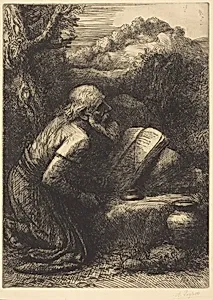
Saint Jerome, 2nd plate
1826 to 1850
Medium
etching
Dimensions
plate: 37.3 × 27.1 cm (14 11/16 × 10 11/16 in.) sheet: 46.4 × 34 cm (18 1/4 × 13 3/8 in.)
Classification
Department
CG-E
Museum
National Gallery of Art, Washington, D.C.
Credit
Rosenwald Collection
Accession Number
1943.3.5435
Rights
Public Domain
Art Historical Context
In the tranquil glow of Alphonse Legros' *Saint Jerome, 2 plate*, created between 1826 and 1850, we encounter the revered Church Father, Saint Jerome, a symbol of scholarly devotion and penance. Legros, a French-born artist who later thrived in Britain, captures saint—famed for translating the Bible into Latin (the Vulgate)—in a moment of contemplation, evoking the hermit's life of ascetic study amid a skull, books, and perhaps a lion, traditional emblems of his legend. This work reflects 19th-century fascination with historical and religious figures, blending realism with spiritual depth. As an etching on a generous plate measuring 37.3 × 27.1 cm (with a sheet of 46.4 × 34 cm), the piece showcases the medium's intimate power. Etching involves incising lines into a metal plate with acid, allowing for rich tonal contrasts and fine detail—techniques Legros mastered to rival old masters like Rembrandt. Prints like this democratized art, making complex imagery accessible beyond paintings. Housed in the National Gallery of Art's Rosenwald Collection (Department CG-E), this classified print highlights Legros' contributions to graphic arts during a era bridging Romanticism and Realism. A gem for visitors, it invites reflection on faith, knowledge, and artistic legacy.
About the Artist
Alphonse Legros · 1837–1911
Alphonse Legros (1837–1911) was born in Dijon, France, and trained in Paris at the drawing school of Horace Lecoq de Boisbaudran, whose unconventional teaching method — which emphasised memory drawing and acute observation over academic convention — would leave a lasting mark on Legros's practice. At Lecoq's school he formed friendships with Jules Dalou and Auguste Rodin that endured throughout hi...