
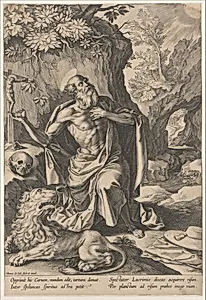
Saint Jerome
n.d.
Medium
Engraving
Dimensions
sheet: 10 1/4 x 6 7/8 in. (26 x 17.5 cm)
Classification
Prints
Department
Drawings and Prints
Museum
Metropolitan Museum of Art, New York, NY
Credit
Harris Brisbane Dick Fund, 1917
Accession Number
17.3.1662
Rights
Public Domain
Tags
Art Historical Context
In the tranquil wilderness depicted in *Saint Jerome*, Flemish engraver Pieter de Jode I captures the iconic penitent saint in a moment of profound contemplation. Dating to the early 17th century (though undated), this engraving showcases de Jode's mastery of the intaglio technique, where intricate lines are incised into a copper plate to create rich tonal contrasts and fine details. As part of a prominent family of Antwerp engravers, de J often reproduced works by leading painters, making religious imagery like this accessible to a wider audience beyond elite collectors. Saint Jerome, one of the four Doctors of the Church, is traditionally shown in desert solitude, accompanied by his loyal lion—symbolizing a healed beast whose paw he extracted a thorn from—alongside a skull evoking mortality and vanitas themes, and a cruciform tree hinting at Christ's sacrifice. These motifs, rooted in Counter-Reformation iconography, underscore Jerome's scholarly devotion to translating the Bible into the Latin Vulgate. The engraving's modest scale (10 1/4 x 6 7/8 in.) belies its cultural weight, as prints like this fueled devotion and artistic exchange across Europe. Acquired through the Harris Brisbane Dick Fund in 1917, this piece from the Metropolitan Museum of Art's Drawings and Prints department exemplifies how engravings bridged art and piety, inviting visitors to reflect on themes of redemption that resonate through centuries.