
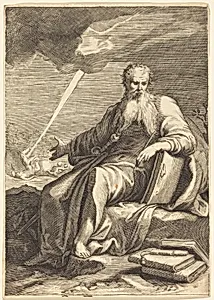
Saint Paul, Seated
1622 or later
Medium
etching on laid paper
Dimensions
sheet (trimmed to plate mark): 13.2 × 9.4 cm (5 3/16 × 3 11/16 in.)
Classification
Department
CG-E
Museum
National Gallery of Art, Washington, D.C.
Credit
R.L. Baumfeld Collection
Accession Number
1969.15.913
Rights
Public Domain
Art Historical Context
Behold *Saint Paul, Seated*, a delicate etching on laid paper after the masterful hand of Jacques Callot, dating to 1622 or later. Callot, a leading French printmaker of the Baroque era, was renowned for his intricate etchings that captured profound emotion and narrative detail in miniature formats. This small work—measuring just 13.2 × 9.4 cm—likely reproduces one of his religious series, portraying the Apostle Paul in contemplative repose, a figure central to Christian theology as the author of key New Testament epistles and a symbol of conversion and faith. Etching, Callot's signature technique, involved drawing acid-resistant lines into a metal plate, allowing for exceptionally fine, expressive lines that convey texture and depth on humble laid paper, which bears the subtle texture of its handmade chains and wires. In the 17th century, such prints democratized religious art, enabling widespread devotion beyond grand altarpieces. This intimate depiction would have offered personal spiritual reflection amid Europe's Counter-Reformation fervor. From the R.L. Baumfeld Collection at the National Gallery of Art (Department CG-E), it exemplifies how prints preserved and proliferated sacred imagery, bridging artistry and piety in an age of religious upheaval.
About the Artist
after Jacques Callot
**Jacques Callot (c. 1592–1635)**, the master whose designs inspired the works attributed "after Jacques Callot," was a pioneering French Baroque printmaker and draftsman born in Nancy, capital of the independent Duchy of Lorraine (now northeastern France). From a noble family—his father served as master of ceremonies and herald-at-arms to the Duke of Lorraine—young Callot was apprenticed to a gol...