
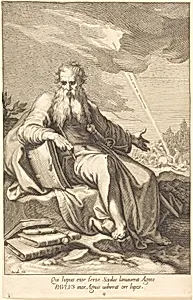
Saint Paul, Seated
c. 1611/1622
Medium
engraving on laid paper
Dimensions
sheet (trimmed within plate mark): 26 × 16.1 cm (10 1/4 × 6 5/16 in.)
Classification
Department
CG-E
Museum
National Gallery of Art, Washington, D.C.
Credit
R.L. Baumfeld Collection
Accession Number
1969.15.355
Rights
Public Domain
Art Historical Context
Jacques Callot's *Saint Paul, Seated (c. 1611/1622) is a masterful engraving on laid paper, measuring 26 × 16.1 cm, from the National Gallery of's R.L. Baumfeld Collection Created during Callot's early career in Florence under Medici patronage, this print captures the apostle in a moment of quiet contemplation, emblematic of the Counter-Reformation's emphasis on personal devotion to saints. Callot, a pioneering French Baroque printmaker influenced by Mannerism, excelled in religious subjects that bridged Italian elegance with Northern precision. Engraving, Callot's preferred medium here, involved meticulously incising a copper plate with a burin to create fine, expressive lines, then printing onto laid paper—distinguished by its textured chains and wires for superior ink absorption. This technique allowed for exceptional detail in Paul's robes, facial intensity, and subtle shading, making the image both intimate and reproducible for widespread devotional use across Europe. As a highlight of 17th-century printmaking, the work showcases Callot's virtuosity before his fame with large-scale series like the *Miseries of War*. It invites visitors to appreciate how such portable art democratized sacred imagery, fostering spiritual connection in an era of religious fervor.
About the Artist
Jacques Callot · 1592–1635
Jacques Callot (1592–1635) was a French printmaker and draftsman from the Duchy of Lorraine, widely regarded as one of the first great artists to practice the graphic arts exclusively. His more than 1,400 etchings chronicled the breadth of 17th-century life, from Medici court festivities to the brutal realities of warfare. Callot revolutionized etching through technical innovations including the é...