
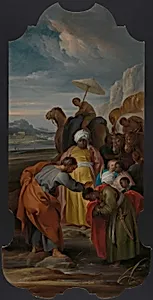
Saint Philip Baptizes the Eunuch
1748
Medium
oil on canvas
Dimensions
h c.215cm × w c.108.5cm
Classification
painting, overmantel
Museum
Rijksmuseum, Amsterdam
Rights
Public Domain
About this artwork
Schoorsteenstuk met een voorstelling van De doop van de Kamerling (Handelingen 8:36-40). Onderdeel van de Beuningkamer.
Art Historical Context
**Saint Philip Baptizes the Eun** (1748) by Jacob Wit captures a pivotal biblical moment from Acts 836-40, where the apostle Philip baptizes the eunuch in a river, symbolizing early Christian conversion and outreach. This oil-on-canvas overmantel painting, measuring approximately 215 x 108.5 cm, was custom-designed as a *schoorsteenstuk*—a decorative piece above fireplace—to adorn the grand Beuningkamer, likely part of an opulent Dutch interior from the mid-18th century. Wit, a leading Dutch Rococo artist (1695–1754), excelled in such architectural integrations, blending dynamic compositions with elegant, light-filled scenes. His fluid brushwork and vibrant colors evoke emotion and drama, characteristic of the Rococo's graceful ornamentation, while nodding to Baroque traditions in history painting. The tall, narrow format suits its overmantel role, drawing the eye upward in a harmonious room ensemble. As a testament to 18th-century Dutch prosperity and piety, this work reflects how affluent patrons commissioned biblical narratives to elevate domestic spaces, merging faith with refined artistry. Visitors today can appreciate its role in immersive period rooms, offering a window into Enlightenment-era devotion and decorative mastery.
About the Artist
Jacob de Wit · 1695–1754
Comment on works: Religious; Allegory; Bas-relief