
Saint Pierre
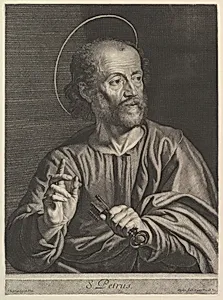
Medium
Etching
Dimensions
sheet: 21 x 15 9/16 in. (53.3 x 39.5 cm) image: 17 1/16 x 12 5/8 in. (43.4 x 32 cm)
Classification
Prints
Department
Drawings and Prints
Museum
Metropolitan Museum of Art, New York, NY
Credit
The Elisha Whittelsey Collection, The Elisha Whittelsey Fund, 1969
Accession Number
69.573.6
Rights
Public Domain
Tags
Art Historical Context
**Saint Pierre**, an exquisite etching attributed to Jean Morin after Philippe de Champaigne captures the revered Apostle Saint Peter in a striking portrait. Champaigne, a leading Flemish Baroque artist active in 17th-century France, renowned for his realistic, spiritually intense figures influenced by Rubens and his own Jansenist piety. Morin, a skilled French engraver, faithfully reproduced Champaigne's designs, transforming paintings into accessible prints that spread their devotional power across Europe during the Counter-Reformation era. This exemplifies etching's technical brilliance: acid bites into a metal plate to create intricate lines, allowing Morin's delicate shading and textures to convey Saint Peter's solemn gaze and saintly aura. At 17 x 12 inches, the image's intimate scale invites close contemplation, highlighting the Baroque emphasis on emotional depth and divine humanity. Etchings like this were vital for disseminating sacred imagery to pilgrims and collectors, bridging elite art with popular devotion. Housed in the Metropolitan Museum of Art's Drawings and Prints department as part of The Elisha Whittelsey Collection, *Saint Pierre* endures as a testament to collaborative artistry and the enduring cultural veneration of Peter, the rock upon which the Church was built. Visitors will appreciate its timeless blend of portraiture and piety.
About the Artist
Jean Morin|Philippe de Champaigne · 1605–1650
Jean Morin (c. 1605–1650) was one of the most accomplished French engravers of the seventeenth century, a master of the portrait print whose work stands among the finest examples of French graphic art in its era. Little is known about his early life or training, though his technique suggests exposure to both French and Flemish engraving traditions, the latter being the dominant force in European p...