
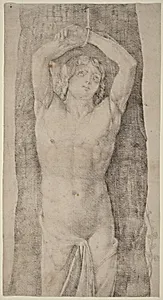
Saint Sebastian
c. 1509
Medium
engraving
Dimensions
sheet: 22 x 11.8 cm (8 11/16 x 4 5/8 in.)
Classification
Department
CG-E
Museum
National Gallery of Art, Washington, D.C.
Credit
Rosenwald Collection
Accession Number
1949.5.36
Rights
Public Domain
Art Historical Context
Jacopo de’ Barbari’s *Saint Sebastian*, created around 1509, captures the enduring appeal of this early Christian martyr through the intimate scale of an engraving. Measuring just 22 by 11.8 centimeters, the print presents the saint bound to a tree or column, his body pierced by arrows—a subject that resonated deeply in Renaissance Europe as both a plea for protection against plague and a celebration of steadfast faith. As an engraving, the work exemplifies the medium’s growing importance in the early sixteenth century. Unlike paintings confined to churches or private chapels, engravings could be printed in multiples and circulated widely, allowing artists to share refined compositions with collectors across Europe. De’ Barbari, an Italian printmaker active in both Venice and the German courts, helped bridge northern and southern artistic traditions through such portable works. Today housed in the National Gallery of Art’s Rosenwald Collection, this delicate sheet invites viewers to appreciate how a modest-sized print could carry profound devotional meaning while demonstrating the technical precision engraving made possible.
About the Artist
Jacopo de' Barbari · 1497–1516
Jacopo de' Barbari (c. 1460/70–before 1516) was an Italian painter, printmaker, and miniaturist of Venetian background whose career unfolded across the courts and workshops of northern Europe, making him one of the most important conduits between Italian Renaissance art and the northern artistic tradition in the years around 1500. Little is known of his training or his early decades; Alvise Vivari...