
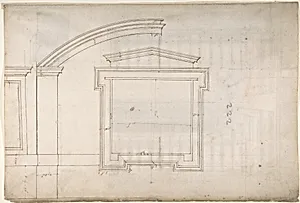
St. Peter's, apse, window, elevation (recto) Unidentified, portal, elevation (verso)
early to mid-16th century
Medium
Dark brown ink, black chalk, and incised lines
Dimensions
sheet: 16 7/8 x 11 7/16 in. (42.9 x 29 cm)
Classification
Drawings
Department
Drawings and Prints
Museum
Metropolitan Museum of Art, New York, NY
Credit
Gift of Janos Scholz and Anne Bigelow Scholz, in memory of Flying Officer Walter Bigelow Rosen, RCAF, 1949
Accession Number
49.92.89
Rights
Public Domain
Tags
Art Historical Context
This exquisite double-sided architectural drawing, attributed to Etienne DuPérac or an anonymous French artist of early to mid-16 century, captures precise elevations of Renaissance grandeur. The recto features the window in the apse of. Peter's Basilica in Rome—a monumental project then underway, symbolizing the era's fusion of classical revival and Christian innovation. The verso depicts an unidentified portal, showcasing the meticulous planning behind ecclesiastical architecture. Crafted with dark brown ink black chalk, and incised lines on a sheet measuring 16⅞ × 11½ inches, the work reveals advanced drafting techniques. Incised lines indicate it served as a template for engraving or transfer, a common practice among 16th-century architects and printmakers like DuPérac, who documented Rome's wonders. These media allowed for fine detail, emphasizing proportions and structural harmony central to Renaissance design. Housed in the Metropolitan Museum of Art's Drawings and Prints department (gift of Janos and Anne Bigelow Scholz, 1949), this rarity offers a window—literally—into the collaborative genius shaping St. Peter's, one of history's greatest basilicas. It reminds us how such sketches bridged imagination and stone, influencing architecture for centuries.
About the Artist
Etienne DuPérac|Anonymous, French, 16th century · 1535–1604
Comment on works: architect; painter